 Add to Chrome
 Add to Firefox
 Add to Edge
Manifold-Aware Information Gain and Lower Bounds for Gaussian-Process Bandits on Riemannian Quotient Spaces
May 13, 2026
We prove a regret lower bound for Gaussian-process bandits on a smooth compact Riemannian manifold $\M$ of dimension $d$ with intrinsic Matérn-$ν$ kernel ($ν>d/2$) that exposes how the geometry of the arm space enters the constant. For any algorithm and time horizon $T$ exceeding an explicit threshold, the worst-case expected regret over the RKHS-ball $\|f\|_{\Hil_{k_ν}}\!\le\!B$ satisfies \begin{multline*} \E[R_T(f)]\;\ge\;c_*(d,ν)\,B^{d/(2ν+d)}\,σ_n^{2ν/(2ν+d)} \\ \cdot\,\vol_g(\M)^{ν/(2ν+d)}\,T^{(ν+d)/(2ν+d)}(\log T)^{ν/(2ν+d)}. \end{multline*} The exponent matches the Vakili--Khezeli--Picheny upper bound \cite{vakili2021information}; the $\vol_g(\M)^{ν/(2ν+d)}$ factor is, to our knowledge, the first explicit volume-dependent geometric constant in a manifold GP-bandit lower bound. We extend the analysis in five directions: (i)~a companion Assouad-style proof gives a different lower bound with a strictly smaller $T$-exponent $(2ν+3d)/(4(ν+d))$ but with a polylog factor of the form $1/(\log\log T)^{(2ν+d)/(4(ν+d))}$, sharpening the $(\log T)^{ν/(2ν+d)}$ Fano polylog of Theorem~\ref{thm:main}; (ii)~we prove a $|G|^{1/2}$ upper bound on the regret of an extrinsic-kernel GP-UCB algorithm on a quotient space $\M=\Mt/G$, plus a bracketing theorem (Theorem~\ref{thm:gauge-bracket}); the precise constant is conjectured to take the modulated form $(1+(|G|-1)h(\rinj/κ))^{1/2}$ (Conjecture~\ref{conj:gauge-modulated}), validated numerically on $\SO(3)$; (iii)~we write the leading constant $c_*(d,ν)$ out fully; (iv)~we extract a curvature dependence $1+O(K\eps_T^2)$ via Bishop--Gromov; (v)~we transfer the bound to the Bayesian regret framework via the Yang--Barron / Castillo et al.\ Bayesian-Fano transfer.

Geometry-Aware Multi-Armed Bandits for Antenna Beam Selection on Spheres, Tori, $\SO(3)$, and Reconfigurable Intelligent Surfaces
May 13, 2026Beam alignment in mmWave phased arrays and RIS-assisted links is a stochastic bandit under both short TTI budgets and Doppler-induced non-stationarity. The arm space is a Riemannian manifold: $\sphere^2$ for steering, $\torus^n$ for phase combining, $\SO(3)$ for panel orientation, or the discrete torus $(\mathbb Z_B)^M$ with up to $K\!\sim\!10^{90}$ configurations for $B$-level RIS ($B\!=\!2^b$, $b$ bits/element); the intrinsic Matérn kernel of Borovitskiy et al.\ provides the base GP. We contribute two algorithmic pieces. \textbf{(C1)} A Kronecker-factorised intrinsic-product Matérn kernel on $(\mathbb Z_B)^M$ evaluating in $O(M)$ table lookups, making GP-UCB tractable at $K\sim 10^{90}$ where the extrinsic alternative is infeasible. \textbf{(C2)} AdaptiveGP-v2, an online sliding-window controller that selects $W$ by per-sample marginal likelihood, with predictive-variance and drift $z$-score reset triggers and a post-reset $β$-boost. On a four-speed ($v\!\in\!\{0.02,0.08,0.12,0.20\}$~km/h), $20$-seed paired campaign at $T\!=\!3000$, AdaptiveGP-v2 is statistically indistinguishable from the hand-tuned fixed-window oracle at every speed (Holm--Bonferroni-corrected paired differences cross zero); the operational benefit is the absence of a deployment-time per-speed calibration step, not a mean-regret improvement. On four static 3GPP-style mmWave benchmarks, intrinsic-kernel GP-UCB reduces cumulative regret by $25$--$45\%$ vs.\ codebook UCB1/Thompson and by $10$--$33\%$ vs.\ Euclidean-ambient GP-UCB on the toroidal arm spaces; a wideband OFDM ablation on a $100$~MHz channel confirms the advantage persists under frequency-selective fading ($\sim\!32$~Mbps/UE at initial access vs.\ UCB1). A third-party-simulator sanity check on Sionna CDL is reported in Section~V.
NTIRE 2026 Challenge on Robust AI-Generated Image Detection in the Wild
Apr 13, 2026This paper presents an overview of the NTIRE 2026 Challenge on Robust AI-Generated Image Detection in the Wild, held in conjunction with the NTIRE workshop at CVPR 2026. The goal of this challenge was to develop detection models capable of distinguishing real images from generated ones in realistic scenarios: the images are often transformed (cropped, resized, compressed, blurred) for practical usage, and therefore, the detection models should be robust to such transformations. The challenge is based on a novel dataset consisting of 108,750 real and 185,750 AI-generated images from 42 generators comprising a large variety of open-source and closed-source models of various architectures, augmented with 36 image transformations. Methods were evaluated using ROC AUC on the full test set, including both transformed and untransformed images. A total of 511 participants registered, with 20 teams submitting valid final solutions. This report provides a comprehensive overview of the challenge, describes the proposed solutions, and can be used as a valuable reference for researchers and practitioners in increasing the robustness of the detection models to real-world transformations.
ForgeryVCR: Visual-Centric Reasoning via Efficient Forensic Tools in MLLMs for Image Forgery Detection and Localization
Feb 15, 2026Existing Multimodal Large Language Models (MLLMs) for image forgery detection and localization predominantly operate under a text-centric Chain-of-Thought (CoT) paradigm. However, forcing these models to textually characterize imperceptible low-level tampering traces inevitably leads to hallucinations, as linguistic modalities are insufficient to capture such fine-grained pixel-level inconsistencies. To overcome this, we propose ForgeryVCR, a framework that incorporates a forensic toolbox to materialize imperceptible traces into explicit visual intermediates via Visual-Centric Reasoning. To enable efficient tool utilization, we introduce a Strategic Tool Learning post-training paradigm, encompassing gain-driven trajectory construction for Supervised Fine-Tuning (SFT) and subsequent Reinforcement Learning (RL) optimization guided by a tool utility reward. This paradigm empowers the MLLM to act as a proactive decision-maker, learning to spontaneously invoke multi-view reasoning paths including local zoom-in for fine-grained inspection and the analysis of invisible inconsistencies in compression history, noise residuals, and frequency domains. Extensive experiments reveal that ForgeryVCR achieves state-of-the-art (SOTA) performance in both detection and localization tasks, demonstrating superior generalization and robustness with minimal tool redundancy. The project page is available at https://youqiwong.github.io/projects/ForgeryVCR/.
Universal Anti-forensics Attack against Image Forgery Detection via Multi-modal Guidance
Feb 06, 2026The rapid advancement of AI-Generated Content (AIGC) technologies poses significant challenges for authenticity assessment. However, existing evaluation protocols largely overlook anti-forensics attack, failing to ensure the comprehensive robustness of state-of-the-art AIGC detectors in real-world applications. To bridge this gap, we propose ForgeryEraser, a framework designed to execute universal anti-forensics attack without access to the target AIGC detectors. We reveal an adversarial vulnerability stemming from the systemic reliance on Vision-Language Models (VLMs) as shared backbones (e.g., CLIP), where downstream AIGC detectors inherit the feature space of these publicly accessible models. Instead of traditional logit-based optimization, we design a multi-modal guidance loss to drive forged image embeddings within the VLM feature space toward text-derived authentic anchors to erase forgery traces, while repelling them from forgery anchors. Extensive experiments demonstrate that ForgeryEraser causes substantial performance degradation to advanced AIGC detectors on both global synthesis and local editing benchmarks. Moreover, ForgeryEraser induces explainable forensic models to generate explanations consistent with authentic images for forged images. Our code will be made publicly available.
A Quality-Centric Framework for Generic Deepfake Detection
Nov 08, 2024


This paper addresses the generalization issue in deepfake detection by harnessing forgery quality in training data. Generally, the forgery quality of different deepfakes varies: some have easily recognizable forgery clues, while others are highly realistic. Existing works often train detectors on a mix of deepfakes with varying forgery qualities, potentially leading detectors to short-cut the easy-to-spot artifacts from low-quality forgery samples, thereby hurting generalization performance. To tackle this issue, we propose a novel quality-centric framework for generic deepfake detection, which is composed of a Quality Evaluator, a low-quality data enhancement module, and a learning pacing strategy that explicitly incorporates forgery quality into the training process. The framework is inspired by curriculum learning, which is designed to gradually enable the detector to learn more challenging deepfake samples, starting with easier samples and progressing to more realistic ones. We employ both static and dynamic assessments to assess the forgery quality, combining their scores to produce a final rating for each training sample. The rating score guides the selection of deepfake samples for training, with higher-rated samples having a higher probability of being chosen. Furthermore, we propose a novel frequency data augmentation method specifically designed for low-quality forgery samples, which helps to reduce obvious forgery traces and improve their overall realism. Extensive experiments show that our method can be applied in a plug-and-play manner and significantly enhance the generalization performance.
Multi-modal Document Presentation Attack Detection With Forensics Trace Disentanglement
Apr 10, 2024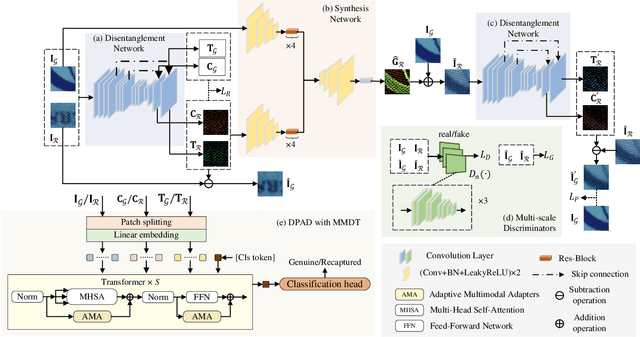
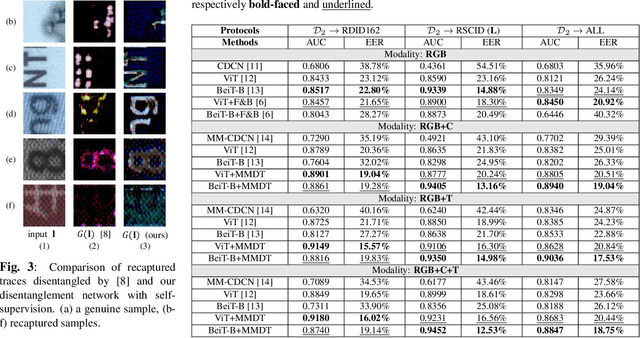
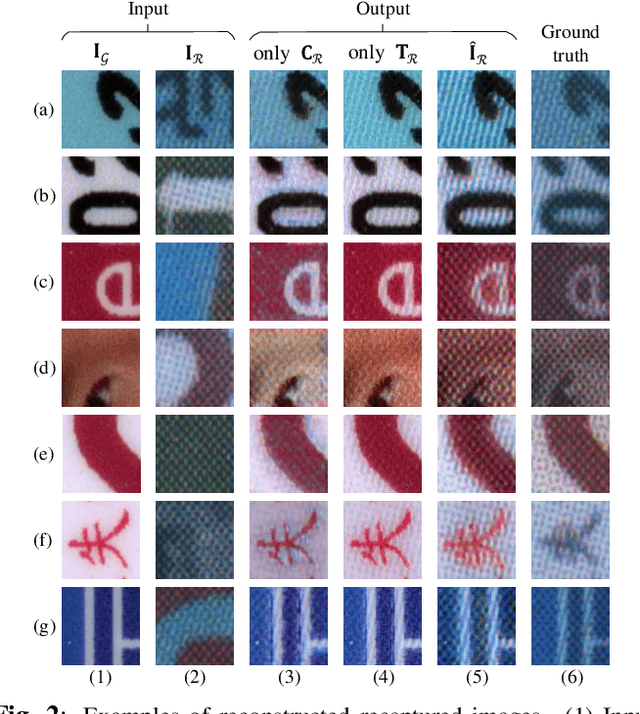
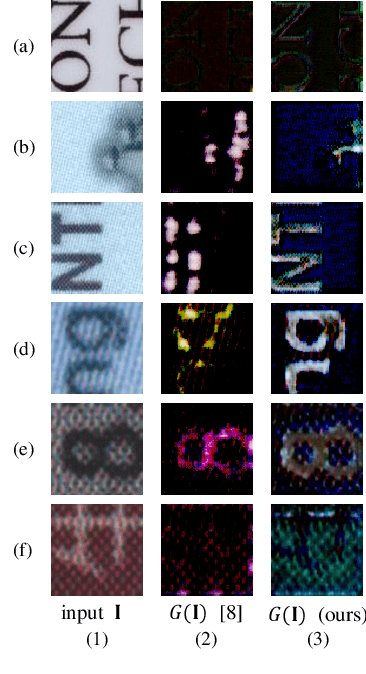
Document Presentation Attack Detection (DPAD) is an important measure in protecting the authenticity of a document image. However, recent DPAD methods demand additional resources, such as manual effort in collecting additional data or knowing the parameters of acquisition devices. This work proposes a DPAD method based on multi-modal disentangled traces (MMDT) without the above drawbacks. We first disentangle the recaptured traces by a self-supervised disentanglement and synthesis network to enhance the generalization capacity in document images with different contents and layouts. Then, unlike the existing DPAD approaches that rely only on data in the RGB domain, we propose to explicitly employ the disentangled recaptured traces as new modalities in the transformer backbone through adaptive multi-modal adapters to fuse RGB/trace features efficiently. Visualization of the disentangled traces confirms the effectiveness of the proposed method in different document contents. Extensive experiments on three benchmark datasets demonstrate the superiority of our MMDT method on representing forensic traces of recapturing distortion.
SHIELD : An Evaluation Benchmark for Face Spoofing and Forgery Detection with Multimodal Large Language Models
Feb 06, 2024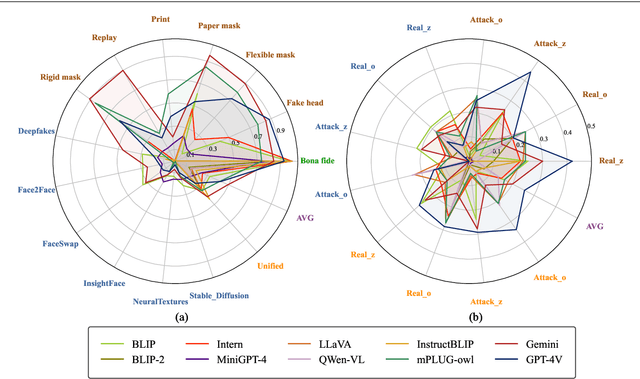
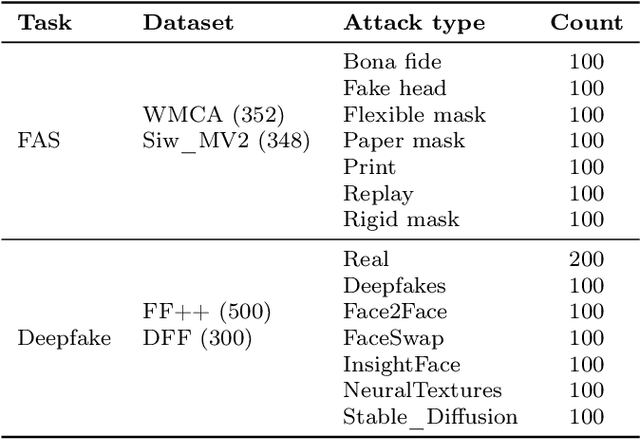
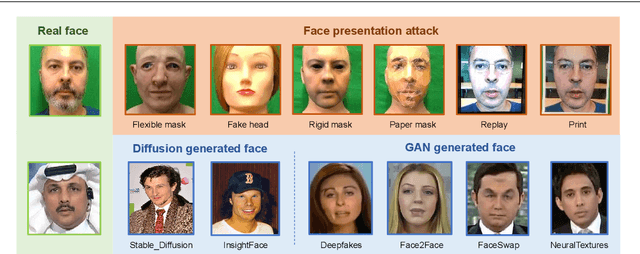
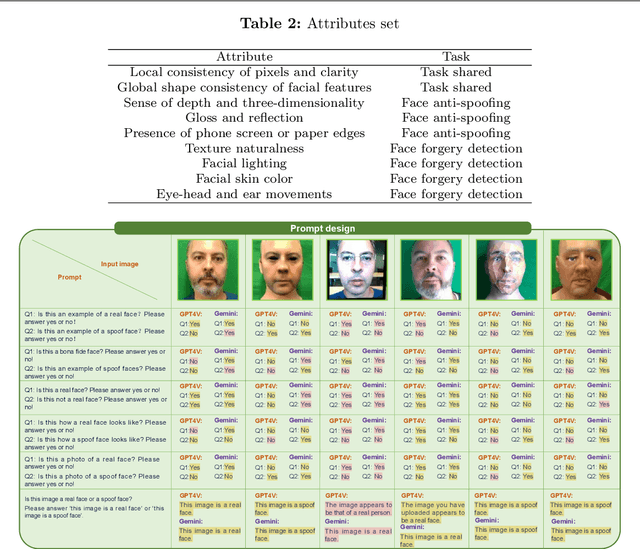
Multimodal large language models (MLLMs) have demonstrated remarkable problem-solving capabilities in various vision fields (e.g., generic object recognition and grounding) based on strong visual semantic representation and language reasoning ability. However, whether MLLMs are sensitive to subtle visual spoof/forged clues and how they perform in the domain of face attack detection (e.g., face spoofing and forgery detection) is still unexplored. In this paper, we introduce a new benchmark, namely SHIELD, to evaluate the ability of MLLMs on face spoofing and forgery detection. Specifically, we design true/false and multiple-choice questions to evaluate multimodal face data in these two face security tasks. For the face anti-spoofing task, we evaluate three different modalities (i.e., RGB, infrared, depth) under four types of presentation attacks (i.e., print attack, replay attack, rigid mask, paper mask). For the face forgery detection task, we evaluate GAN-based and diffusion-based data with both visual and acoustic modalities. Each question is subjected to both zero-shot and few-shot tests under standard and chain of thought (COT) settings. The results indicate that MLLMs hold substantial potential in the face security domain, offering advantages over traditional specific models in terms of interpretability, multimodal flexible reasoning, and joint face spoof and forgery detection. Additionally, we develop a novel Multi-Attribute Chain of Thought (MA-COT) paradigm for describing and judging various task-specific and task-irrelevant attributes of face images, which provides rich task-related knowledge for subtle spoof/forged clue mining. Extensive experiments in separate face anti-spoofing, separate face forgery detection, and joint detection tasks demonstrate the effectiveness of the proposed MA-COT. The project is available at https$:$//github.com/laiyingxin2/SHIELD
S-Adapter: Generalizing Vision Transformer for Face Anti-Spoofing with Statistical Tokens
Sep 07, 2023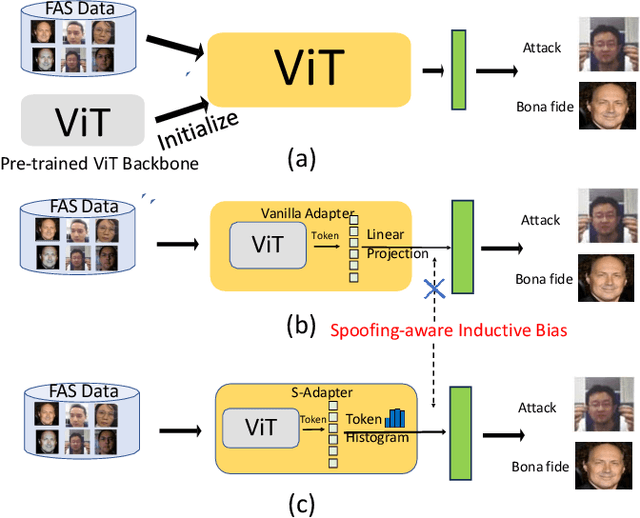
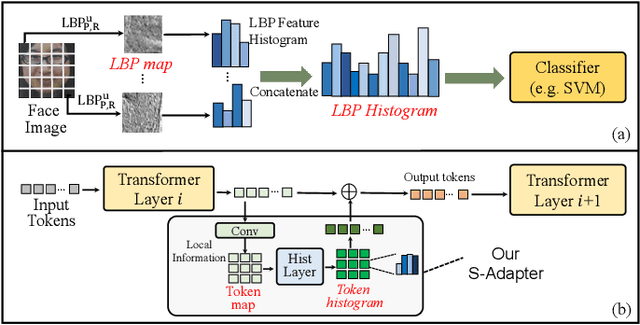
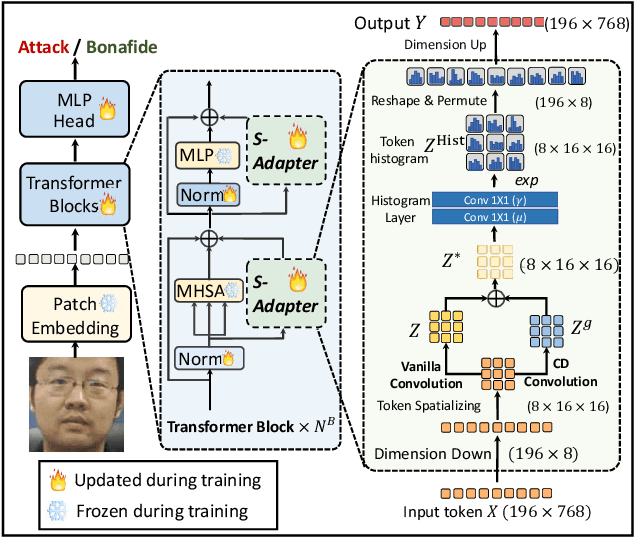
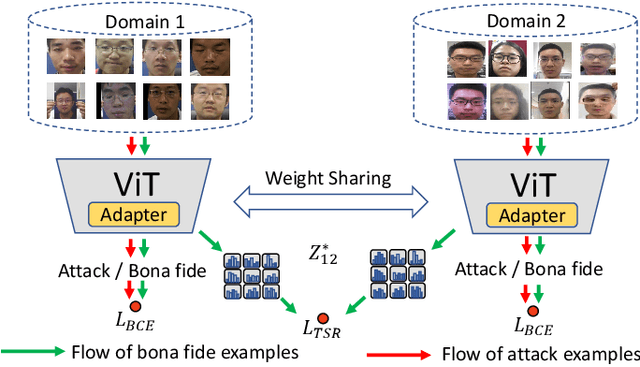
Face Anti-Spoofing (FAS) aims to detect malicious attempts to invade a face recognition system by presenting spoofed faces. State-of-the-art FAS techniques predominantly rely on deep learning models but their cross-domain generalization capabilities are often hindered by the domain shift problem, which arises due to different distributions between training and testing data. In this study, we develop a generalized FAS method under the Efficient Parameter Transfer Learning (EPTL) paradigm, where we adapt the pre-trained Vision Transformer models for the FAS task. During training, the adapter modules are inserted into the pre-trained ViT model, and the adapters are updated while other pre-trained parameters remain fixed. We find the limitations of previous vanilla adapters in that they are based on linear layers, which lack a spoofing-aware inductive bias and thus restrict the cross-domain generalization. To address this limitation and achieve cross-domain generalized FAS, we propose a novel Statistical Adapter (S-Adapter) that gathers local discriminative and statistical information from localized token histograms. To further improve the generalization of the statistical tokens, we propose a novel Token Style Regularization (TSR), which aims to reduce domain style variance by regularizing Gram matrices extracted from tokens across different domains. Our experimental results demonstrate that our proposed S-Adapter and TSR provide significant benefits in both zero-shot and few-shot cross-domain testing, outperforming state-of-the-art methods on several benchmark tests. We will release the source code upon acceptance.
Image Copy-Move Forgery Detection via Deep Cross-Scale PatchMatch
Aug 08, 2023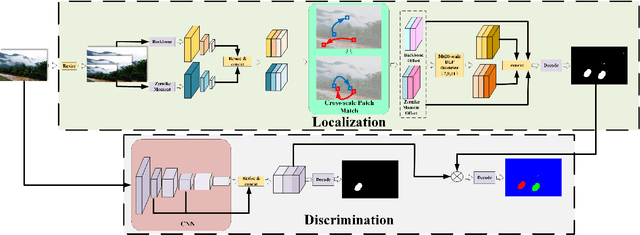
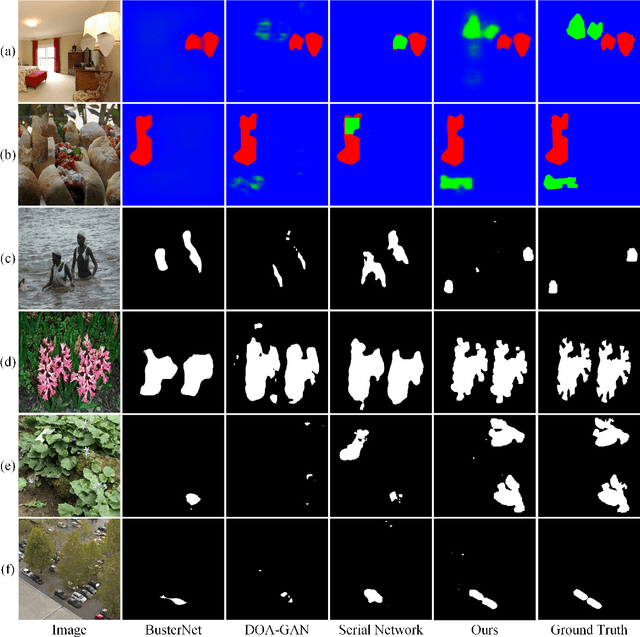
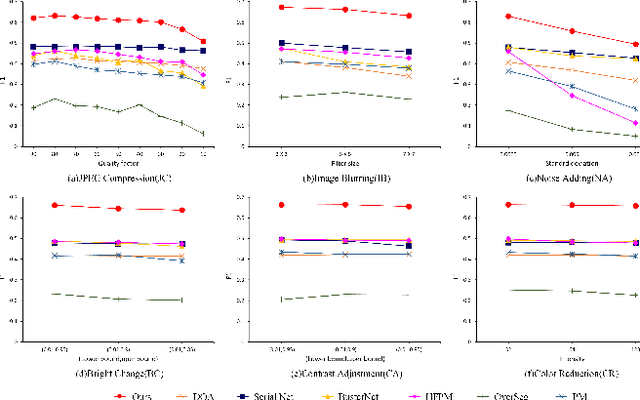
The recently developed deep algorithms achieve promising progress in the field of image copy-move forgery detection (CMFD). However, they have limited generalizability in some practical scenarios, where the copy-move objects may not appear in the training images or cloned regions are from the background. To address the above issues, in this work, we propose a novel end-to-end CMFD framework by integrating merits from both conventional and deep methods. Specifically, we design a deep cross-scale patchmatch method tailored for CMFD to localize copy-move regions. In contrast to existing deep models, our scheme aims to seek explicit and reliable point-to-point matching between source and target regions using features extracted from high-resolution scales. Further, we develop a manipulation region location branch for source/target separation. The proposed CMFD framework is completely differentiable and can be trained in an end-to-end manner. Extensive experimental results demonstrate the high generalizability of our method to different copy-move contents, and the proposed scheme achieves significantly better performance than existing approaches.